
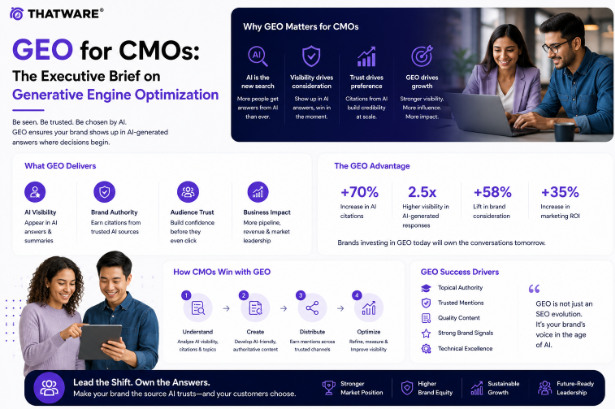
You don’t need to become an expert in how large language models work. But you do need a working understanding of what Generative Engine Optimization is, why it matters for your brand’s growth, and what it takes to do it well. Because if AI-driven search is changing how your buyers find, evaluate, and trust solutions — and it is — then GEO belongs on your marketing radar.
This is the executive brief. No deep dives into schema markup or training data mechanics. Just the strategic picture you need to make informed decisions.
The Shift That’s Already Happening
Search behavior is changing faster than most marketing plans have accounted for. A growing share of information discovery, research, and product evaluation is happening through AI assistants and generative search features — ChatGPT, Perplexity, Google’s AI Overview, Bing Copilot. These tools don’t return a list of links and let users decide. They generate synthesized answers. They cite sources. They make recommendations.
The brands that get cited, recommended, and referenced in those answers are building a new form of digital presence. The brands that don’t are effectively invisible to a growing segment of their potential buyers — particularly the research-led, high-consideration segments that matter most for most B2B and premium consumer categories.
This isn’t a future state. It’s happening now, and the gap between brands that have invested in GEO and those that haven’t is already widening.
What GEO Actually Is
Generative Engine Optimization is the practice of optimizing your brand’s presence — content, entity signals, external citations, technical structure — to appear in AI-generated answers to relevant queries.
It’s related to traditional SEO, shares some techniques and principles, and benefits from a strong SEO foundation. But it’s distinct in important ways. SEO is primarily about ranking pages in a list. GEO is about being referenced in synthesized answers. The signals that drive success overlap but don’t entirely align.
The strategic question GEO asks is: when someone asks an AI system a question that your brand should be part of the answer to, are you in that answer? If the answer is often no, you have a GEO problem.
Why This Matters Commercially
The commercial case for GEO is strongest in categories with high-consideration purchasing decisions — B2B, professional services, high-value consumer goods, healthcare, financial services. These are the categories where buyers do significant research before making a contact or purchase decision, and where an AI-generated summary can meaningfully shape the consideration set.
Being in that consideration set — being one of three or four vendors an AI tool mentions as worth evaluating — has real pipeline value. Not showing up means your competitors are filling that space.
There’s also a brand equity dimension. Consistent presence in AI-generated answers builds the kind of low-key, ambient credibility that accumulates over time. Buyers who’ve “seen your name” in multiple AI contexts arrive with more pre-established trust. This is the equivalent of earned media’s brand-building effect, operating in a new channel.
The Strategic Questions to Ask
As a CMO evaluating GEO investment, a few questions cut to the core of the opportunity:
Where are we currently in AI answers about our category? Run some relevant queries in ChatGPT and Perplexity. Are you cited? How? Where are your competitors showing up that you aren’t? This five-minute exercise is often more clarifying than a lengthy strategy discussion.
What’s our current GEO foundation? Traditional SEO authority, content depth, structured data implementation, entity presence — these are the inputs. A brand with strong SEO foundations has a meaningful head start in GEO. A brand that has underinvested in content and technical SEO has more foundational work to do.
What are buyers asking AI tools in our category? This is the GEO equivalent of keyword research. Understanding the specific questions your target buyers are asking AI systems — and where you currently appear or don’t in those answers — defines the opportunity space.
What’s our competitive position in AI citations? GEO is a competitive landscape. Understanding where category leaders and key competitors are generating AI citations — what content, what entity signals, what external references — tells you both the standards you’re competing against and the gaps you can exploit.
Resourcing GEO: Build, Buy, or Partner
Most CMOs face a build-vs.-buy question when adding GEO to the marketing mix. The honest assessment:
GEO is cross-functional by nature. It involves content strategy, technical SEO, PR and earned media, structured data implementation, and performance measurement. Very few in-house teams have all of these competencies at the level of depth required, at least not initially.
The most common effective model is a partnership: an internal owner who understands the strategic picture and can coordinate across functions, combined with external GEO expertise that provides the technical depth, prompt landscape analysis, and optimization execution.
The best GEO agencies for B2B / SaaS / eCommerce will integrate with your existing marketing function rather than operating as a separate silo. The internal-external handoff on strategy, content, and reporting should feel seamless. If it doesn’t, that’s usually a sign of misaligned expectations rather than a GEO problem per se.
Metrics and Board-Level Reporting
How do you report GEO performance to a board or executive team accustomed to traffic, leads, and pipeline metrics?
In the early stages, GEO metrics will be process-oriented: citation rate (what percentage of target prompts include your brand), prompt coverage (how many distinct query types you’re cited in), share of AI voice (your citations relative to competitors’). These are leading indicators.
Over time, the connection to business outcomes becomes more measurable: AI referral traffic trends, branded search volume growth, awareness metrics in buyer research surveys. The path from AI citation to pipeline is longer and less direct than paid search, but it’s real — and it compounds.
Enterprise GEO optimization agency partnerships that include regular executive reporting aligned to your business objectives make this story easier to tell internally. The agencies worth working with will help you build the reporting framework that connects GEO activity to outcomes your CFO and CEO care about.
The Window Isn’t Closing Yet — But It’s Narrowing
Here’s the honest strategic reality: GEO is still early enough that first-mover advantage is genuinely available. The brands building AI citation authority now are doing so in a landscape where most of their competitors haven’t seriously started. That window won’t be open indefinitely.
This isn’t a sky-is-falling pitch. Traditional search isn’t going away, and GEO results take time to build. But for brands in categories where AI-driven discovery is already reshaping the buyer journey, waiting another year or two to start is a decision that will be visible in competitive outcomes.
The CMOs who get ahead of this shift will have built something durable by the time their competitors realize they need to catch up.
GEO isn’t a replacement for what’s working. It’s the next layer — building the brand presence that matters in the channels your buyers are already using. That’s always been the job.